
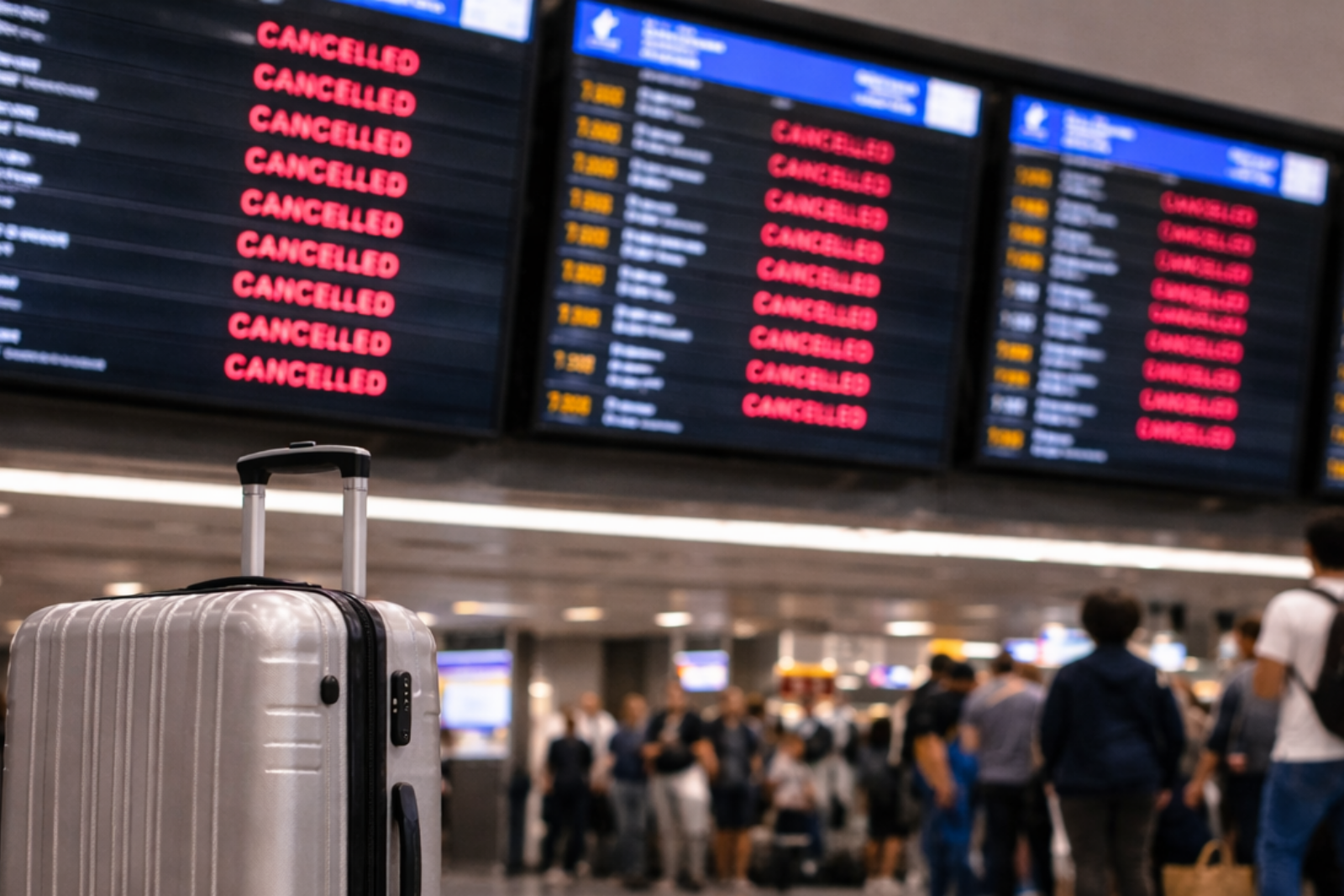
The rapidly escalating conflict involving Iran and retaliatory strikes across the region has triggered widespread airspace closures, airport shutdowns, and thousands of flight cancellations.
The ripple effect has left hundreds of thousands of travelers stranded in airports, hotels, and transit hubs across the globe.
Major aviation hubs like Dubai, Abu Dhabi, and Doha—normally some of the busiest international connection points in the world—have been forced to suspend flights as missile strikes and security threats spread across the region.
For travelers caught in the middle of it all, the experience has been confusing, stressful, and in some cases frightening.
Editor’s Note: This is a developing situation. Information, travel advisories, and flight operations may change rapidly as events continue to unfold. This article was updated on March 5.
A Global Aviation Network Suddenly Shut Down
Airspace closures across several countries—including Iran, Iraq, Qatar, Israel, Kuwait, and the United Arab Emirates—forced airlines to cancel thousands of flights and reroute others across longer, more expensive paths.
According to flight tracking data, more than 20,000 flights have been canceled across major Middle Eastern airports since the conflict began on February 28, 2026, when coordinated U.S. and Israeli military strikes targeted sites inside Iran.
Some of the airports most affected include:
- Dubai International Airport (UAE)
- Zayed International Airport in Abu Dhabi (UAE)
- Hamad International Airport in Doha (Qatar)
- Ben Gurion Airport in Tel Aviv (Israel)
Dubai, the world’s busiest international airport, remained closed or severely restricted for a fourth day on Tuesday, leaving tens of thousands of passengers stranded.
Governments have been scrambling to get their citizens out, but organizing evacuations has proven difficult as commercial flights remain suspended and security conditions continue to evolve.
Travelers Stranded Across the Region
Among the travelers caught in the chaos is Lauren, an American traveler from New York who was passing through Dubai on what was supposed to be a quick layover.
Instead, she ended up stranded in the city for four days.
“I had a normal layover in Dubai,” she told Top Five Travel Guide. “And then the bombing started.”
Flights were immediately grounded as airports across the region shut down. Lauren booked a hotel nearby and assumed she’d be rebooked shortly.
“One day turned into two, then three, then four,” she said.
Each night she would rebook a flight for the following morning—only to wake up and discover it had been canceled again.
With airports closed across much of the region, travelers had almost no clear options. At the same time, U.S. advisories were urging Americans to “DEPART NOW due to major safety risks.” For Lauren and many others, that message only added to the frustration.
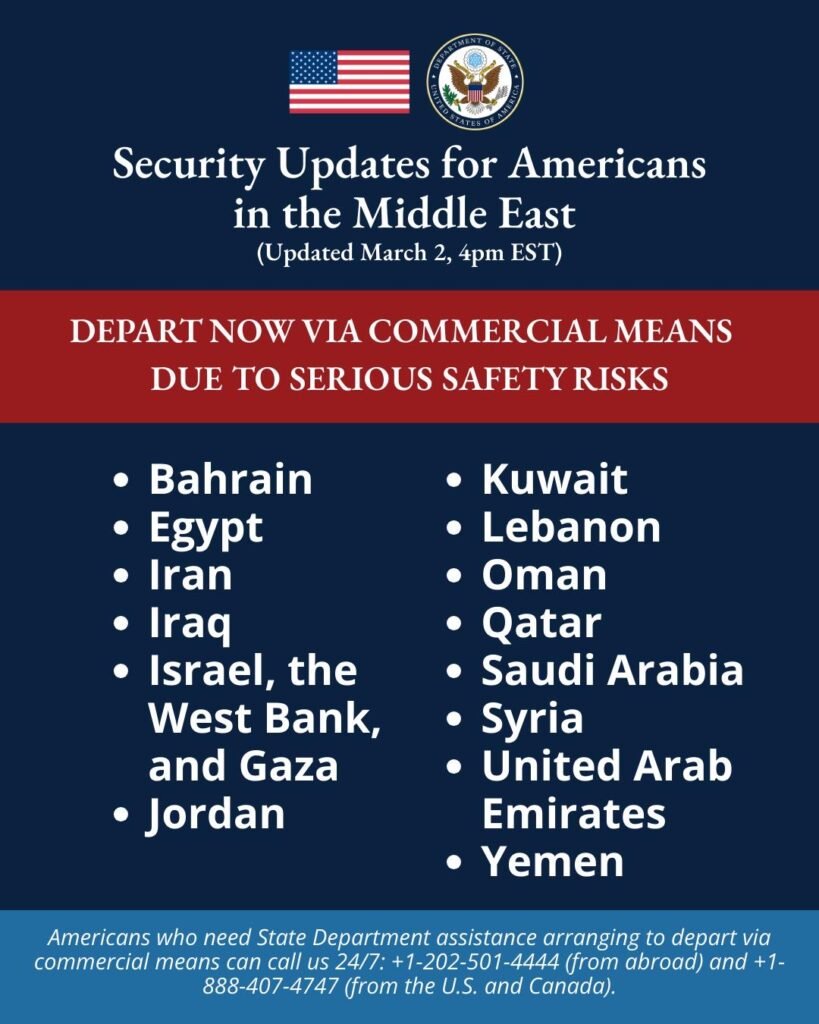
“I got a notification saying to get out of the UAE,” she said. “And I was like—how am I supposed to get out? There are no flights.”
Lauren and her friend had signed up for alerts through the U.S. State Department’s Smart Traveler Enrollment Program (STEP) and joined a WhatsApp notification group run by the department.
“The messages were saying things like ‘stay away from windows’ and ‘please evacuate,’” she explained. “But there was no actual guidance on how to leave.”
Meanwhile, Lauren began seeing posts online from other travelers who were trying to leave the UAE by driving across the border to Oman, where some flights were still operating.
But the plan came with its own uncertainties. The trip would be expensive, and there was no guarantee she would actually find a flight once she arrived.
There were other complications as well. All of this is unfolding during Ramadan, when many businesses and services across the region operate on limited hours, and with shelter-in-place advisories also circulating.
A Gap Between News Headlines and Reality
Like many stranded travelers, Lauren also began noticing a disconnect between official announcements and what people were experiencing on the ground.
She had heard reports that the UAE government planned to subsidize hotel stays for tourists stranded by the airport closures.
But when she asked her hotel staff about it, the answer was far from clear.
“The receptionist told me they hadn’t received anything like that,” she said. “They said they’d try to work something out later, but my credit card was still on file. As far as I knew, I was still getting charged.”
The experience highlighted just how chaotic the situation had become, with travelers hearing one thing in the news while hotels, airlines, and government officials were still trying to figure out what was actually happening on the ground.
Confusion Over U.S. Warnings
Even the U.S. government itself appeared to be sending mixed signals about how prepared officials were for the crisis. President Trump said Tuesday there was no time to make evacuation plans because U.S. strikes in Iran happened so quickly.
Yet later Wednesday, White House press secretary Karoline Leavitt said Americans had been warned earlier to avoid travel to the Middle East, pointing to State Department Level 4 “Do Not Travel” advisories issued for Saudi Arabia on January 14 and expanded warnings released February 11.
The advisory for the United Arab Emirates, however, had remained at Level 2: “Exercise Increased Caution.”
On March 3, the State Department raised its travel advisory for the United Arab Emirates to Level 3: “Reconsider Travel,” while also urging Americans already in the country to consider leaving if they could do so safely.
The State Department is now also encouraging non-emergency U.S. personnel to leave the UAE, and the U.S. Embassy in Abu Dhabi and Consulate in Dubai closed, suspending in-person services.
Luckily for Lauren, on Wednesday, March 4, after four days stranded in Dubai, she finally received word from the U.S. government that evacuation arrangements were being organized for her and other stranded Americans.
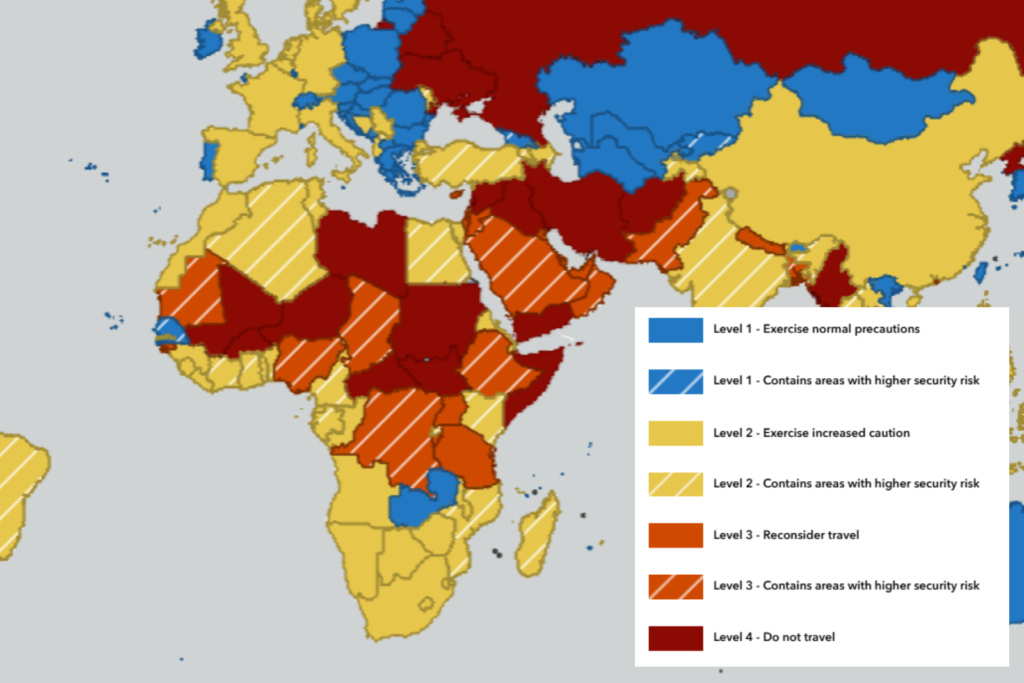
U.S. Department of State | Travel Advisories Map – As of March 4, 2026
Another Traveler Exits Kuwait Via Saudi Arabia
Another traveler, Alyssa Ramos, documented her experience exiting Kuwait on her Facebook page, My Life’s a Travel Movie. She has been living abroad for eight years and traveling full-time for twelve, documenting her journeys through her travel blog, My Life’s a Travel Movie, and social media.
She explained that when she traveled to Kuwait, the U.S. State Department still listed the country under a Level 1 travel advisory, meaning there was little indication at the time that the region would soon face widespread conflict and airspace disruptions.
But as tensions escalated and flights across the Middle East began shutting down, she suddenly found herself scrambling to leave.
On March 2, she wrote that she and five others were attempting to self-evacuate from Kuwait by crossing into Saudi Arabia, hoping to catch flights out from there.
According to her posts, travelers were largely organizing their own exit plans.
“[We had] absolutely no help from the US gov,” she wrote, explaining that she began coordinating rides and sharing information with other stranded travelers through a group chat she created. “Locals helped us get a driver to take us all the way through the danger zone of Kuwait (where the US bases are) through the barren Saudi desert, and to Riyadh which was also dangerous and where the US embassy had been bombed earlier that day.”
Two days later, on March 4, she posted an update saying she had successfully evacuated Kuwait — though the departure itself came with another tense moment.
After boarding the aircraft, she said the plane was temporarily stopped on the tarmac “due to imminent danger overhead,” leaving passengers waiting inside and unsure what was happening outside.
Despite eventually making it out safely, she continued to highlight what she described as a lack of official assistance. While she says she never expected or depended on the U.S. government to help, she questioned public claims that officials were doing everything possible to assist Americans trying to leave the region.
Alyssa continues helping other travelers who remain stuck in the region. She is currently coordinating group chats with more than 1,000 people who are still trying to leave, helping connect them with transfer companies and organizing shared rides so travelers can split transportation costs.
Travelers can DM her on Instagram at @mylifesamovie with their location and she will get them connected to a group chat.
She added that government-funded charter buses could make it much easier to safely move large groups of stranded travelers out of the area.
Governments Scramble to Evacuate Citizens
As travel disruptions worsen, governments around the world have begun organizing evacuation efforts for citizens stranded across the region.
In some cases, travelers have already been able to leave through government-arranged flights or coordinated departures. Others, however, say they are still relying largely on their own networks to find ways out as the situation continues to evolve.
Several European countries have announced large-scale evacuation plans, while others have issued urgent advisories telling citizens to leave the Middle East as soon as possible.
The United Kingdom has begun organizing charter flights to bring stranded nationals home, with the first government-arranged flight departing March 4 from Muscat, Oman, and additional flights planned in the coming days.
Officials described the operation as one of the largest consular challenges the country has faced since the COVID-19 pandemic, as thousands of travelers remain scattered across Gulf cities while airspace restrictions continue to disrupt commercial flights.
Timeline of U.S. Warnings and Advisories
- February 23, 2026: The U.S. orders the departure of non-essential diplomatic personnel and families from Lebanon as tensions with Iran increase.
- February 27, 2026: U.S. officials advise Americans in Israel to consider leaving while commercial flights remain available.
- February 28, 2026: The conflict escalates when U.S. and Israeli forces launch strikes inside Iran. Iranian retaliation begins the same day.
- February 28, 2026: The U.S. State Department issues a worldwide caution alert warning Americans of potential travel disruptions and security risks.
- March 2, 2026: The State Department urges Americans to “depart now” from more than a dozen Middle Eastern countries including the UAE, Saudi Arabia, Qatar, Kuwait, and Jordan.
- March 3, 2026: The U.S. orders the departure of non-essential government personnel and families from the United Arab Emirates.
- March 4, 2026: U.S. officials confirm they are working to help evacuate Americans stranded across the Middle East as commercial travel remains heavily disrupted.
What Travelers Should Know Now
For travelers with upcoming trips through the Middle East, the situation remains highly fluid. Airspace restrictions, airport closures, and flight cancellations continue to shift as governments assess security risks across the region.
For now, travelers are being advised to closely monitor airline updates and government advisories before heading to the airport.
For thousands already caught in the disruption, however, the priority is much simpler—finding a safe way home.


Jamye Molina is a freelance writer and former travel agent who booked corporate and educational travel. She has also spent years living abroad in Spain and exploring the world. Through both her professional experience and personal adventures, she shares insider travel insights and reports on the latest travel news.